
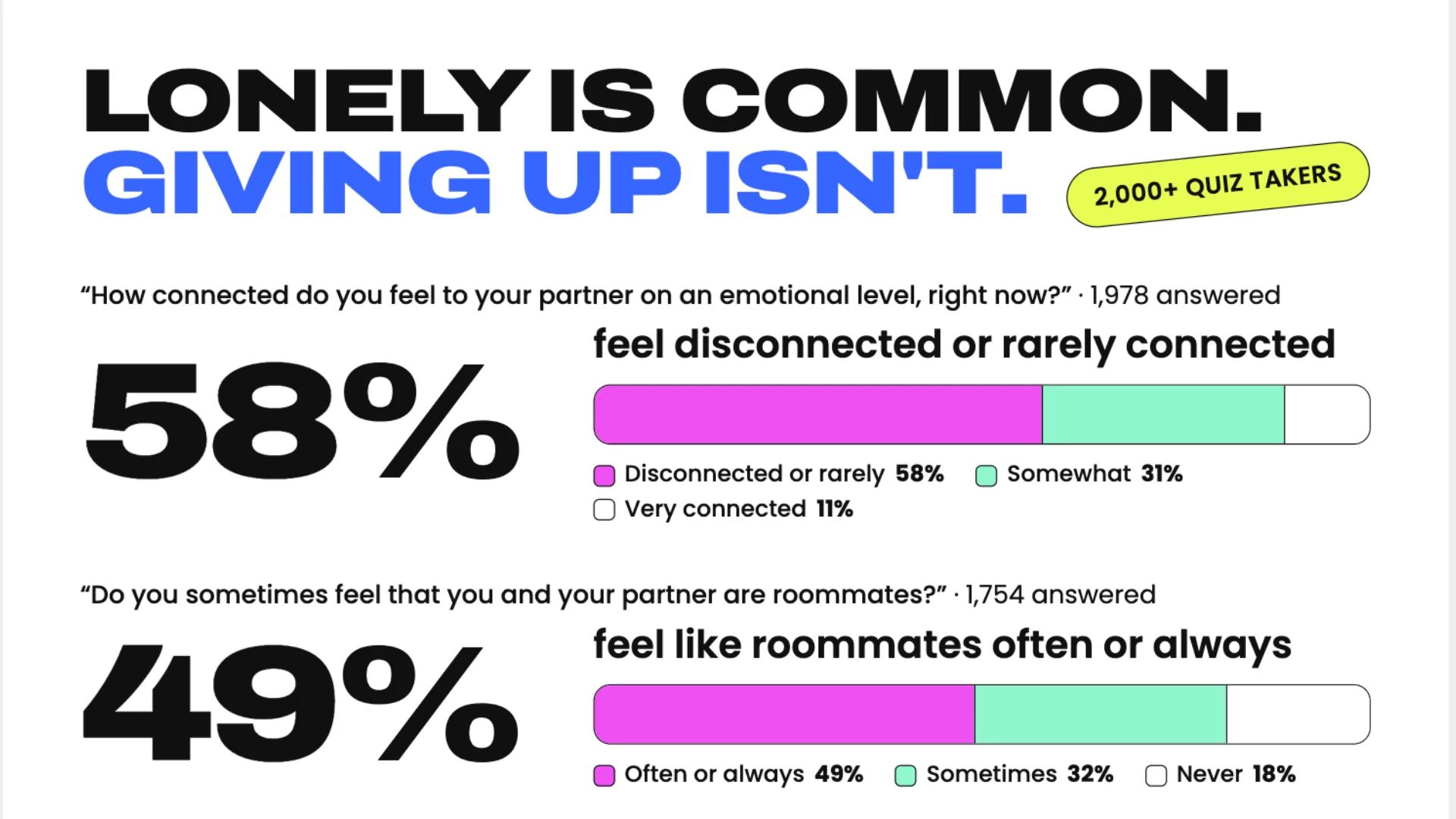
You can love someone, share a bed and a calendar, and still feel profoundly lonely in a relationship. That's sadly a common experience, and it doesn't necessarily mean the relationship needs to end. Of the 2,000+ people who have taken my CARE & Intimacy quiz, over half said they rarely feel connected to their partner or feel disconnected at the moment.
Loneliness in a relationship is usually about emotional distance (you're still in the same house, but the conversations that let you know who the other person is have stopped). This guide will help you work out what's missing and how to bring it up without it escalating into a fight. It will also cover when it's appropriate to seek further support.
Is it normal to feel lonely in a relationship?
Yes, absolutely. I've seen it firsthand in more than 10 years as a couples therapist, and in the results of my CARE & Intimacy Quiz (over 2,000 people have taken it). More than half reported feeling disconnected or only rarely connected to their partner. Even more telling, more than 4 in 5 said they feel like roommates at least some of the time, and almost half (49%) said it happens often or always.
Why you might feel lonely in a relationship
Feeling lonely in a relationship often comes down to how we communicate emotionally. My quiz looks at four areas of a relationship, which I call CARE (Communication, Affection, Resolution, and Equilibrium, how fair and balanced things feel). Those who said they were on 'different planets' scored lower in all of them. Their Communication score averaged 29%, compared with 54% for the rest of us, and their Equilibrium score was 31%, compared with 55%.
So feeling distant shows up in how you talk, how you handle conflict, and how much affection you show. Which is also why "just have more date nights" on its own is rarely going to be the solution.
For most of us, it's far easier to put our thoughts into words than our feelings. That's why couples so easily end up in "thought talk" mode (talking about the news, what we're going to watch on TV, who's going to pick up the kids, who's going to do the washing up, etc.). It's perfectly fine for a relationship to run on that kind of conversation, and it will get the job done. The problem is that if you're always in that mode of conversation, then your relationship can quite easily become more like a business arrangement or just living with a roommate.
True closeness is all about emotional communication, which is about 'dropping in' beneath the surface thoughts to share our inner emotional world (our feelings, our fears, our dreams, our vulnerabilities). If we stop sharing what is actually going on inside us, we can end up sitting right next to the person we love and still feel miles apart.
Avoiding arguments leaves couples feeling on "different planets"
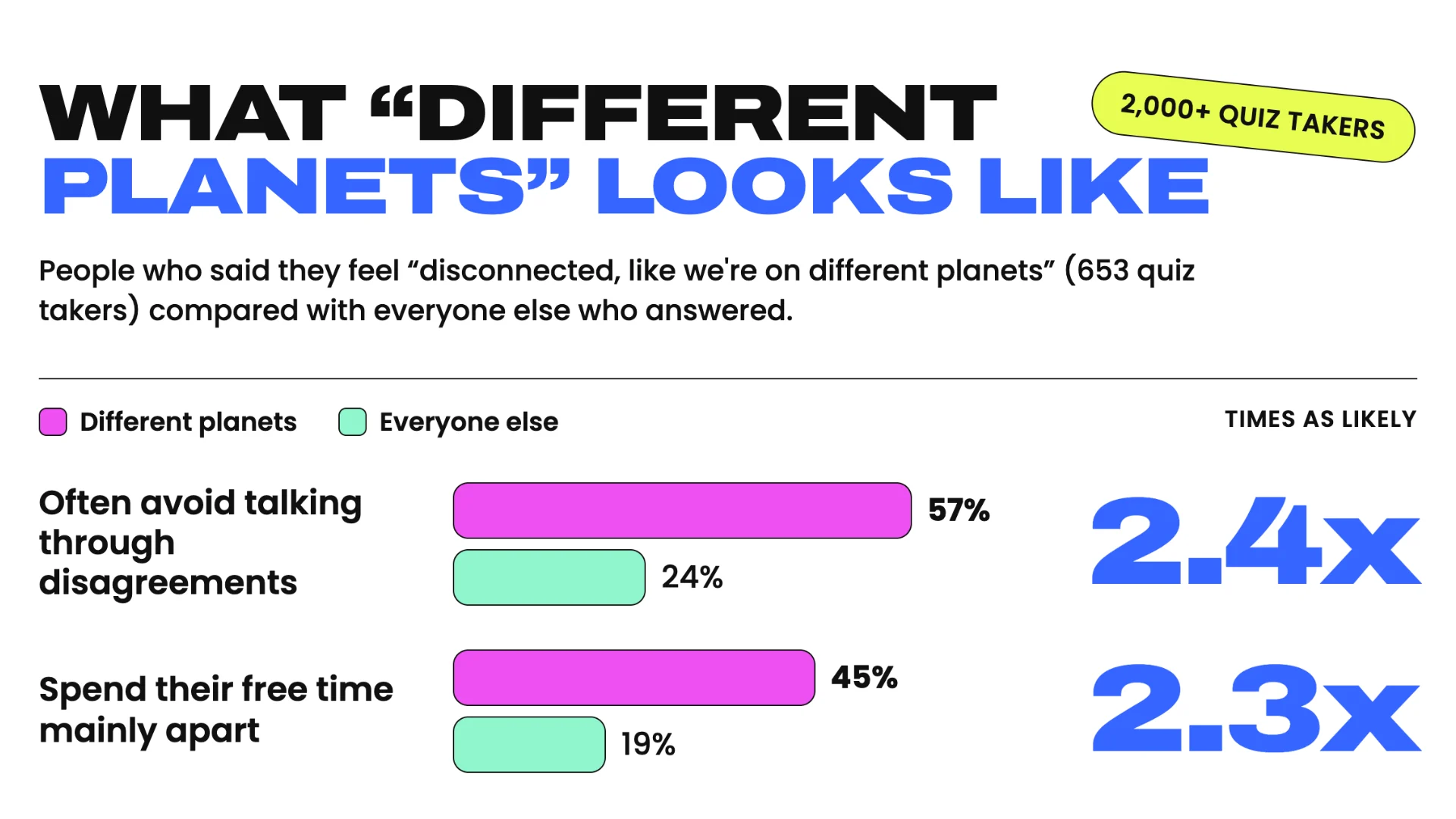
Many people think loneliness just creeps in as romance naturally wanes over time. The truth is that emotional distance tends to develop when we just don't talk about the little hurts and disagreements we have. In our quiz data, the people who felt completely "disconnected" (i.e. they were living on different planets) were more than twice as likely (57% v 24%) to avoid having those conversations.
Of those who say they "always" feel like roommates and their partner is a "stranger", 69% will avoid difficult conversations. If you stop talking about what's bothering you in order to maintain the peace, then you're going to start emotionally and physically distancing yourself. Eventually, you're going to be living two separate lives, and you'll be very lonely.
Feeling unheard starts a chain reaction of loneliness
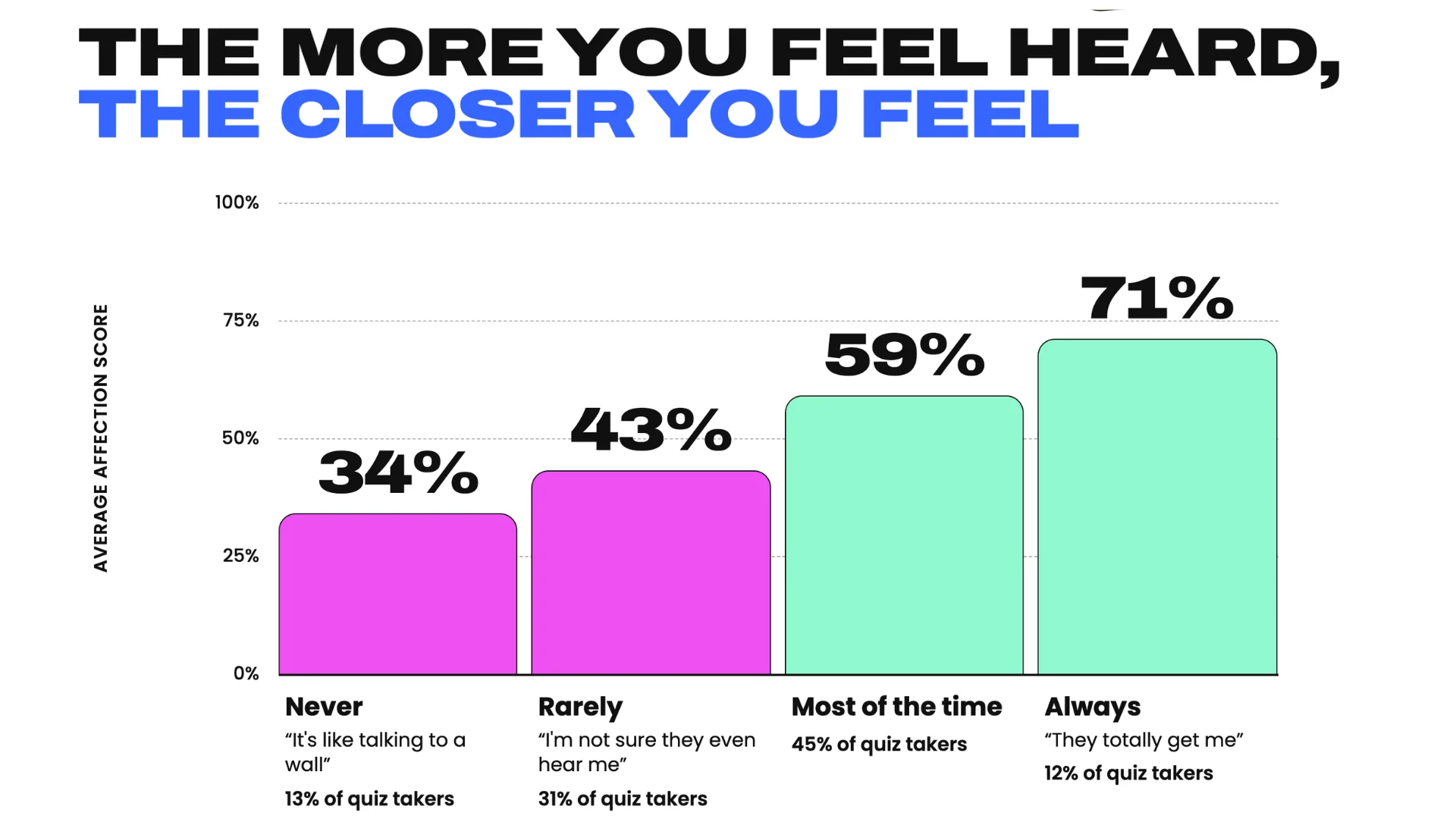
Feeling lonely in a relationship doesn't happen overnight. In my experience, it's often the end of a chain reaction that starts when you stop feeling heard. In my quiz, 31% of people said their partner "rarely" listens when they tell them what they need, and another 13% said "never."
When you try to share a difficult day or a bit of your vulnerability, and your partner doesn't get it, dismisses it, or jumps in to "solve" it, sharing your feelings and needs starts to feel unsafe and pointless. You close down and stop bringing your inner world to them. The quiz answers fit that pattern. People who "rarely" feel heard were more than twice as likely to say they rarely express their emotional needs (43% vs 20%), nearly twice as likely to say their fears and dreams rarely come up (49% vs 26%), and twice as likely to say they often feel like roommates (53% vs 26%). It happens so gradually that neither of you notices, and soon you talk only about the dishes, the schedule, and the bills.
Even close couples feel disconnected, they just come back to talk later
If you and your partner get overwhelmed during arguments or occasionally misunderstand each other, it does not mean your relationship is failing. In fact, one of the most reassuring findings from our quiz is that happy, deeply connected couples don't get communication right 100% of the time—they still get emotionally flooded, need space to cool down, and sometimes miss the mark when listening.
For example, among couples who feel "somewhat connected" (meaning they are mostly in sync, with a few off days), 69% say their partner listens "most of the time, but sometimes misses the mark". Even among couples who say they never feel like roommates, 61% admit that when emotions run high, "one of us pulls back, but we get back to it" (making them nearly three times as likely to take a breather and return to the conversation as other couples, at 32% vs. 11%).
Curiosity and familiarity
One of the biggest reasons we stop sharing our emotional world is that, over time, we accidentally trade curiosity for familiarity. When you have been with your partner for a long time, it is easy to fall into the trap of acting like an "expert" on their mind—assuming you already know what they are thinking, how they feel, or how they will react. But the moment we think we've completely figured out our partner, we stop truly listening and asking meaningful questions.
Assumptions close the door to genuine dialogue and leave both people feeling unseen and unheard. Rebuilding that connection means shifting from an "expert" back into an "explorer". Even after years together, your partner is like an endless book with new chapters constantly being written; staying curious enough to ask deeper questions—and sharing your own feelings even when you assume your partner already knows everything—is what brings emotional intimacy back to life.

Signs you may be feeling emotionally alone with your partner
1. Your conversations are mostly about logistics
Who's picking up the kids and whether the electricity bill got paid. All of it matters, and none of it is about either of you. When most of what you say to each other in a day could have been sent as a text, it's easy to feel more like business partners running a household than two people in a relationship.
2. You stop bringing your partner the important parts of your day
A good piece of news goes to a friend first, or to nobody at all. The thing you're worried about stays in your head because bringing it up feels like more effort than it's worth. Over time, the relationship starts to hold less and less of your actual life.
3. You feel unheard, so you've started editing yourself
This is one of the clearest patterns in my quiz data. 44% of people who took it said they rarely or never feel heard when they tell their partner what they need, and 13% picked the answer "it's like talking to a wall." People who rarely feel heard were also about twice as likely to say they rarely express their emotional needs at all (43% compared with 20%).
How to tell your partner you feel lonely without blaming them
Most people put this conversation off because they're afraid it'll turn into a fight or that their partner will hear it as an attack. Both are reasonable fears, and both are easier to manage than they seem.
A simple opening script
"I've been feeling far from you lately, and I miss us. I'm not saying it's your fault. Could we find some time to talk about what's been getting in the way?"
The phrase "I miss us" does a lot of work here. It tells your partner that you want more of the relationship, and it's much harder to get defensive about than "you never talk to me."
Pick a time and aim for understanding before solutions
Choose a calm moment when neither of you is rushing off. The middle of an argument tends to go badly, and so does a text at 11 pm.
Once you've said how you feel, ask your partner how things have been for them. Given how many people in my quiz said they rarely feel heard, your partner may feel some version of this too, and the conversation goes much better when you both describe it.
What to do if the conversation turns defensive
If it goes sideways, slow down and name it. Something like "I don't think I said that very well; can I try again?" is enough. It's also fine to stop and pick it up another day, because one conversation rarely settles something that took months to build. If you'd like more on this, I've written a longer piece on how to build emotional intimacy.
How to start reconnecting in small, realistic ways
Big gestures are tempting, but the things that tend to close emotional distance are small and repeated. Here are a few you could try this week.
Make room for the deep conversation when nothing is wrong
A third of the people who took my quiz (33%) said their fears and dreams "don't come up much unless something's wrong." That group was about twice as likely to say they rarely feel heard (46% vs. 24%) and more likely to feel like roommates (49% vs. 28%).
Even if you can only talk about your hopes and worries during a crisis, those conversations come with the crisis attached, and they start to feel risky. Try having one on an ordinary Tuesday, when nothing needs fixing.
A weekly couples check-in
Set a timer for ten minutes. One of you talks about how things have been, and the other only listens and asks one follow-up question. Then you swap. It feels a bit formal at first, but the structure takes the pressure off deciding who should start and what you're supposed to say.
Ask one question that isn't about the to-do list
It can be as simple as "what's been on your mind this week?" or "what are you looking forward to?" If you want a place to start, here are some date-night questions for married couples.
Keep connection going outside the relationship too
One partner can't be someone's whole social world, and expecting them to be tends to make loneliness worse. Time with friends and family takes some pressure off the relationship and often gives you more to bring back to it.
When it may help to talk with a therapist
Sometimes a couple can do this work on their own, and sometimes it helps to have someone in the room. I'd suggest talking to a couples therapist if the same conversation keeps turning into the same fight, or if the distance has lasted for months despite both of you trying. Individual support can also help when the loneliness shows up outside the relationship as well, or when it comes with low mood or anxiety.
Frequently asked questions
Why do I feel lonely even though I love my partner?
Because love and feeling known are two different things, and you can have plenty of the first while running short on the second. Loneliness in a relationship usually means the conversations that let you know each other have thinned out, often because life got busy or because you started avoiding hard subjects. It's very common. More than half of the people who've taken my CARE & Intimacy quiz said they rarely feel connected to their partner right now, and many of them still care a great deal about the relationship.
Can a relationship recover from emotional distance?
Often, yes. Distance usually builds through lots of small moments, and it tends to close the same way, through small, repeated moments of turning toward each other. One of the most hopeful findings in my quiz is that close couples still pull away from each other sometimes. What sets them apart is that someone comes back. If you're both still willing to return to the conversation after a retreat, that's a good foundation to rebuild on.
How do I know whether the problem is me or the relationship?
Often it's a bit of both, and that's fine. A few questions can help you sort it out. Did the loneliness start around a particular change or hurt? Do you feel lonely in your friendships and family relationships too, or mainly with your partner? Would your partner say they feel the distance as well? If it's mostly about this relationship, the conversation and reconnection ideas on this page are a good place to start. If it follows you everywhere, individual support may help alongside them.
What if our relationship doesn't change?
First, try again with a different opening at a different time, because how a conversation starts tends to shape how it goes. Lead with what you miss, and ask how things have been for them. If you've done that more than once and you're still stuck in the same loop, a couples therapist can help, partly because a third person in the room often changes the conversation in ways two people can't on their own.
Is it better to be alone than lonely in a relationship?
That's a real question, and only you can answer it for your relationship. Before deciding, find out whether the distance can change, which means having an honest conversation, trying some of the reconnection ideas here, and possibly seeing a couples therapist. Many couples find their way back. But repair takes two people, and if you've tried and your partner won't engage, or the relationship doesn't feel safe, leaving can also be a reasonable and healthy choice.
Feeling unsafe or feeling lonely
Emotional loneliness is different from fearing your partner. If there are threats, control over your money or movements, or any abuse, the conversation script above isn't the right tool, and your safety comes first. The National Domestic Violence Hotline is available at 1-800-799-7233 or thehotline.org. If you're having thoughts of harming yourself, you can call or text 988 to reach the 988 Suicide & Crisis Lifeline.
The data
The figures on this page come from my CARE & Intimacy quiz, which more than 2,000 people have started since October 2024. Each answer reflects one partner's view of the relationship; people who took it chose to, and it isn't a validated research instrument. When I say two answers "go together," I mean that people who gave one were more likely to give the other, and I'm not claiming that one causes the other.