
The Emotional Intimacy Pyramid is a six-layer model of how couples move from everyday small talk to the conversations that create closeness. The base is pleasantries and logistics. Each layer above asks you to reveal a little more of yourself: your interests, your values, the stories behind them and how those experiences felt. At the peak, you tell your partner how you feel about them.
I created the Emotional Intimacy Pyramid for my work with couples. It's based on Progressive Emotional Communication, a concept from Modern Psychoanalysis. It is a separate model from the Intimacy Pyramid by Dan Drake, Joanna Raabsmith and Matthew Raabsmith, and it isn't affiliated with or endorsed by them. There's a short comparison of the two further down the page.
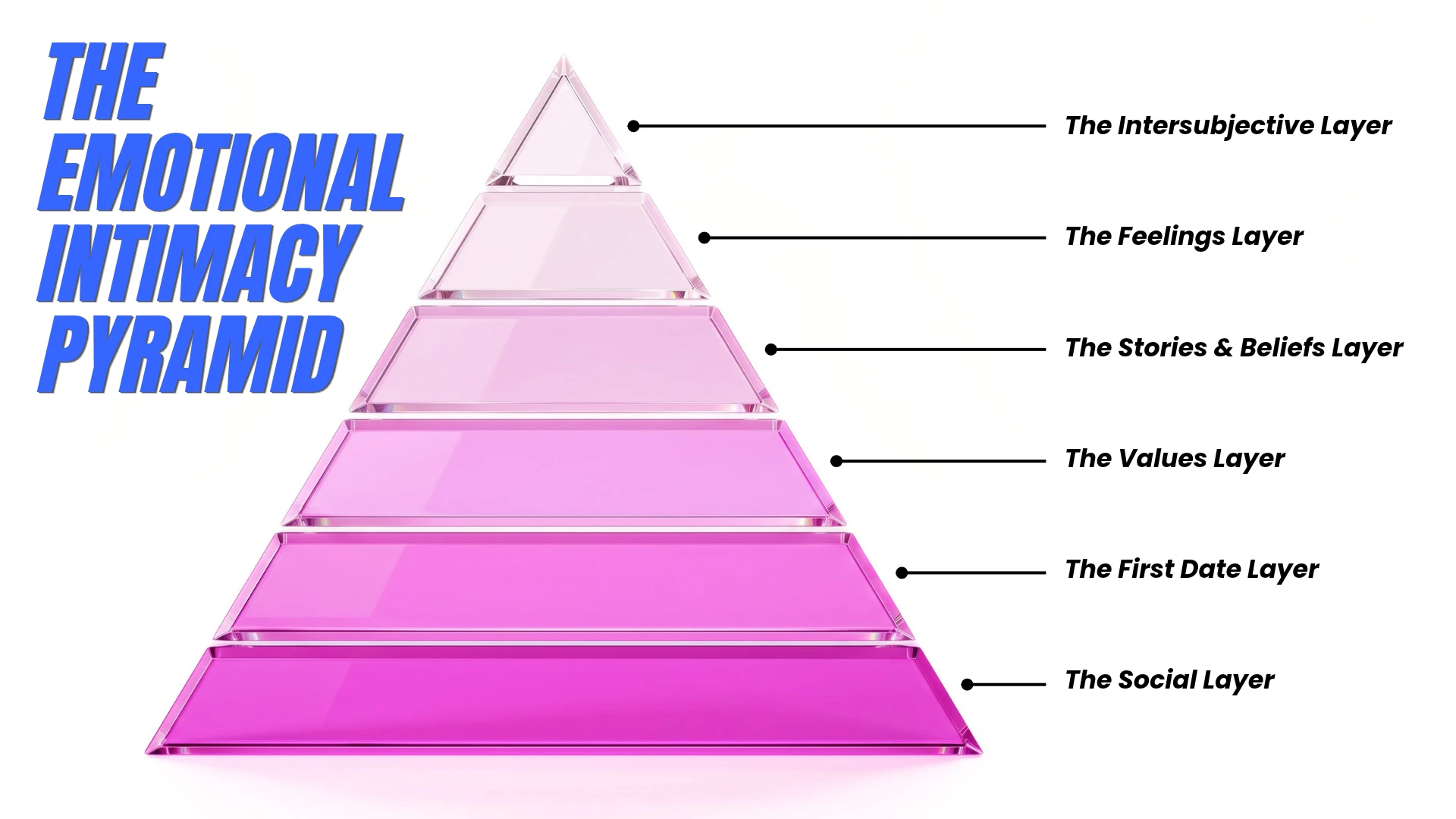
The six levels of intimacy, from the base up:
- The Social Layer: pleasantries and logistics
- The First Date Layer: shared interests, things outside the relationship
- The Values Layer: why those things matter to you
- The Stories & Beliefs Layer: the experiences that shaped what you believe
- The Feelings Layer: how those experiences felt
- The Intersubjective Layer: how you feel about each other
Why couples can talk all evening and still feel lonely
Here's a pattern I see often in my practice. A couple has talked all evening, about work and dinner and the neighbors and what to watch on Netflix. Then, right before bed, one of them says, "I feel like we never really talk anymore." The other is baffled: "We've been talking all night!"
They're both right. There's a big difference between talking to someone and feeling emotionally connected to them. It's possible to spend years talking to your partner every day without having the kinds of conversations that build emotional intimacy, and it usually isn't because people don't love each other. Their conversations keep stopping at the same layer.
Not every conversation needs to be deep. Sometimes you really do just need to ask whether your partner remembered to take the trash out. The trouble starts when nearly all of them stay near the bottom. If that sounds familiar, I've written more about feeling lonely in a relationship.
Where the Emotional Intimacy Pyramid comes from
The model grew out of Progressive Emotional Communication, an idea from the psychoanalyst Louis Ormont, who used it as his standard for whether a therapy group was making progress. In Ormont's account, a session is on course when three things happen at once: people put their feelings into words, they direct those feelings toward each other in the room, and the exchange keeps revealing something new about them.
As a certified group psychotherapist, I've found it translates well to couples. The Emotional Intimacy Pyramid lays it out as a ladder. The lower layers are where couples share information about the world and about themselves. The Feelings Layer is where feelings are put into words. The Intersubjective Layer is where those feelings are directed at each other, which is the step Ormont considered essential and the one couples most often avoid.
The six levels of the Emotional Intimacy Pyramid
To show how the layers work, I'll follow one imaginary couple, Ben and Jen, through a single conversation that climbs all six.
1. The Social Layer: pleasantries and logistics
The Social Layer is where couples swap pleasantries and logistics. "How was your day?" "Fine, thanks." "Busy at work?" "Yeah, pretty busy." Nothing very revealing happens here. You're being friendly, polite and socially appropriate.
This layer does a real job. It gets you through daily life without having to reveal your deepest insecurities every time someone asks how you're doing. But you can know what time your partner got home, what they had for lunch and whether the car needs gas, and still know very little about their inner world.
2. The First Date Layer: finding a third thing
The First Date Layer is talk about things outside the relationship: music, movies, vacations, politics, hobbies, the terrible ending of that TV series. I call this finding a third thing. There's you, there's me, and there's something out in the world we can both talk about.
Ben says he's always been fascinated by space and would love to see the northern lights. Jen says she'd love that too and has heard Iceland is amazing. They've found something in common, and shared interests do help people connect. But neither of them has revealed much about themselves yet. Sharing your thoughts isn't quite the same as sharing yourself.
3. The Values Layer: why it matters to you
The Values Layer is where you move past what you like to why it matters to you. It's the first layer where talking about things turns into revealing yourself.
Jen says, "Traveling is really important to me. I don't want to get to the end of my life and realize I've spent all my time working and never explored the world." She's no longer just saying she likes vacations. She's showing Ben something about how she wants to live.
This is also the first emotional risk, because Ben could disagree with something that matters to her. The more we reveal, the more chance the other person has to understand us, and the more chance they have to reject us.
4. The Stories & Beliefs Layer: where your beliefs came from
The Stories & Beliefs Layer is personal history: how you came to believe what you believe. In my experience it's the layer couples most often overlook.
Jen tells Ben her dad worked incredibly hard and always talked about the places they'd visit when he retired. By the time retirement came, he wasn't well enough. Watching that happen changed how she sees life. Ben now knows something about her childhood, her relationship with her father, and an experience that shaped who she is.
Our partners may know what we do and what we think. Unless we tell them the stories behind those things, they may never understand why we are the way we are. Everything at this layer is still information, though. It's personal, but it describes events and what Jen learned from them.
5. The Feelings Layer: how it felt
The Feelings Layer is where you stop describing what happened and start saying how it felt. It's the same story with the same facts, but now your partner has access to your emotional experience.
Jen tells the story again: "I remember feeling so sad watching him realize some of those dreams weren't going to happen. I think a part of me is frightened I'll make the same mistake. And sometimes I feel guilty for wanting to travel, because I know he never got the chance." That's sadness, fear and guilt.
When someone takes the time to understand our emotional experience, we feel seen, and that person becomes more important in our inner world. All of Jen's feelings so far, though, are about her own life. None of them are about Ben.
6. The Intersubjective Layer: how you feel about each other
The Intersubjective Layer is where you share the feelings that live between the two of you. "Intersubjective" simply means between two people's inner worlds. This is the deepest layer, and the one many couples find hardest.
Compare two sentences. "I've been feeling sad recently" tells your partner about your emotional state. "I've been feeling distant from you recently, and I really miss feeling close to you" tells them how you experience the relationship. The second one invites them into the feeling, shows how much they matter to you, and gives them the power to hurt you.
Ben takes that risk: "Hearing you talk about all this makes me think about our future together, and I really want us to have those adventures. But sometimes when I suggest things and you don't seem interested, I feel a bit rejected." He isn't really talking about travel anymore. Jen could get defensive. Instead she says, "I had no idea you felt rejected when I did that. I think sometimes I get overwhelmed by planning and shut the conversation down. But hearing you say that makes me feel much closer to you."
Many couples can say "I love you," and some can say "I'm angry with you," but a whole range in between goes unsaid. "I feel proud of you." "I felt really touched when you did that." "I really miss how playful we used to be." Or the sentence I'd most like couples to try:
"I miss you, even when you're right next to me."
Set it beside "You never put your phone down." The second complains about your partner's behavior. The first tells them what it feels like to miss them.
What blocks each level of intimacy?
Every layer of the pyramid has its own way of breaking. Usually nobody means to do it. Someone opens up a little, the response lands badly, and the conversation drops back down a level or stops altogether.
What blocks the Social Layer
John Gottman's research calls the small attempts partners make to connect "bids." "Look at that sunset." "You'll never guess who I saw today." You can turn toward a bid by responding, turn away by missing or ignoring it, or turn against it with irritation. In Gottman's Love Lab, the couples he calls "masters" turned toward each other's bids 86% of the time, while the "disasters" did so only 33% of the time (The Gottman Institute). Turn away from enough small bids and your partner stops making them, and the foundation starts to crack.
What blocks the First Date Layer
Your partner mentions a movie they loved, and you explain why the plot made no sense. They were looking for common ground and you've handed them an opponent.
What blocks the Values Layer
When your partner tells you what matters to them, they're also giving you the chance to disagree. Judging takes that chance. If you jump in with your opinion when they only wanted to be heard, it can feel shaming. If you do have a view, ask first: "Do you want my thoughts?" Even a playful label like "dreamer" can tell them this part of them isn't taken seriously.
What blocks the Stories & Beliefs Layer
Your partner tells you about their childhood, and you turn it into a lesson or compare it with your own story. That's preaching, and it makes the conversation about you. Grilling happens when curiosity turns anxious. You fire off questions about who said what and when, until the story feels like a cross-examination.
What blocks the Feelings Layer
Fixing is the most common block here. When Jen says she feels guilty, Ben could reply, "Well, you shouldn't feel guilty. Your dad would probably have wanted you to travel." He means well, but he's telling her why she doesn't need to feel what she feels, which can leave her surprisingly alone. Quick reassurance ("It'll be fine") does the same.
Compare a curious reply: "That sounds really sad. I didn't realize you carried that with you. Does that still worry you now?" Ben isn't fixing anything or disagreeing with her feelings. He's trying to understand them. If you're not sure which your partner wants, ask: "Do you want to be heard, hugged, or helped?"
What blocks the Intersubjective Layer
Here the feeling is about you, so the stakes are highest. Say your partner tells you, "I feel lonely sometimes, even when we're sitting right next to each other." One pull is to divert: change the subject, or point out that they do it too. The other is to get defensive or diagnose: "You're just stressed." Either way, they've taken the biggest risk on the pyramid and been left holding it. Try reflecting back what you heard instead: "I didn't know you felt that way. Tell me more."
How to move one level deeper this week
Don't turn this into a three-hour relationship interrogation. Start small.
Think about a recent conversation with your partner and ask yourself which layer you were on. Then try taking one familiar conversation one layer deeper.
- If your partner tells you about something that happened at work, ask, "How did that feel for you?" before offering advice.
- If they tell you about their childhood, ask, "Do you think that still affects you today?"
- If you're feeling brave, tell them something about how you feel toward them. It's often easier to start with something positive: "I felt really close to you when we were laughing together the other night."
There's no prize for reaching the top layer. Sometimes a conversation about dinner really is just a conversation about dinner. For more ways in, see how to build emotional intimacy.
How the Emotional Intimacy Pyramid compares to the Intimacy Pyramid
The Intimacy Pyramid is a different, five-layer model created by Dan Drake, Joanna Raabsmith and Matthew Raabsmith. Its layers run from Honesty at the base through Safety, Trust and Vulnerability to Intimacy at the top. Matthew and Joanna write that they developed it during their own recovery journey, and it's widely used in relationship repair, especially after betrayal. Their official site explains it in full.
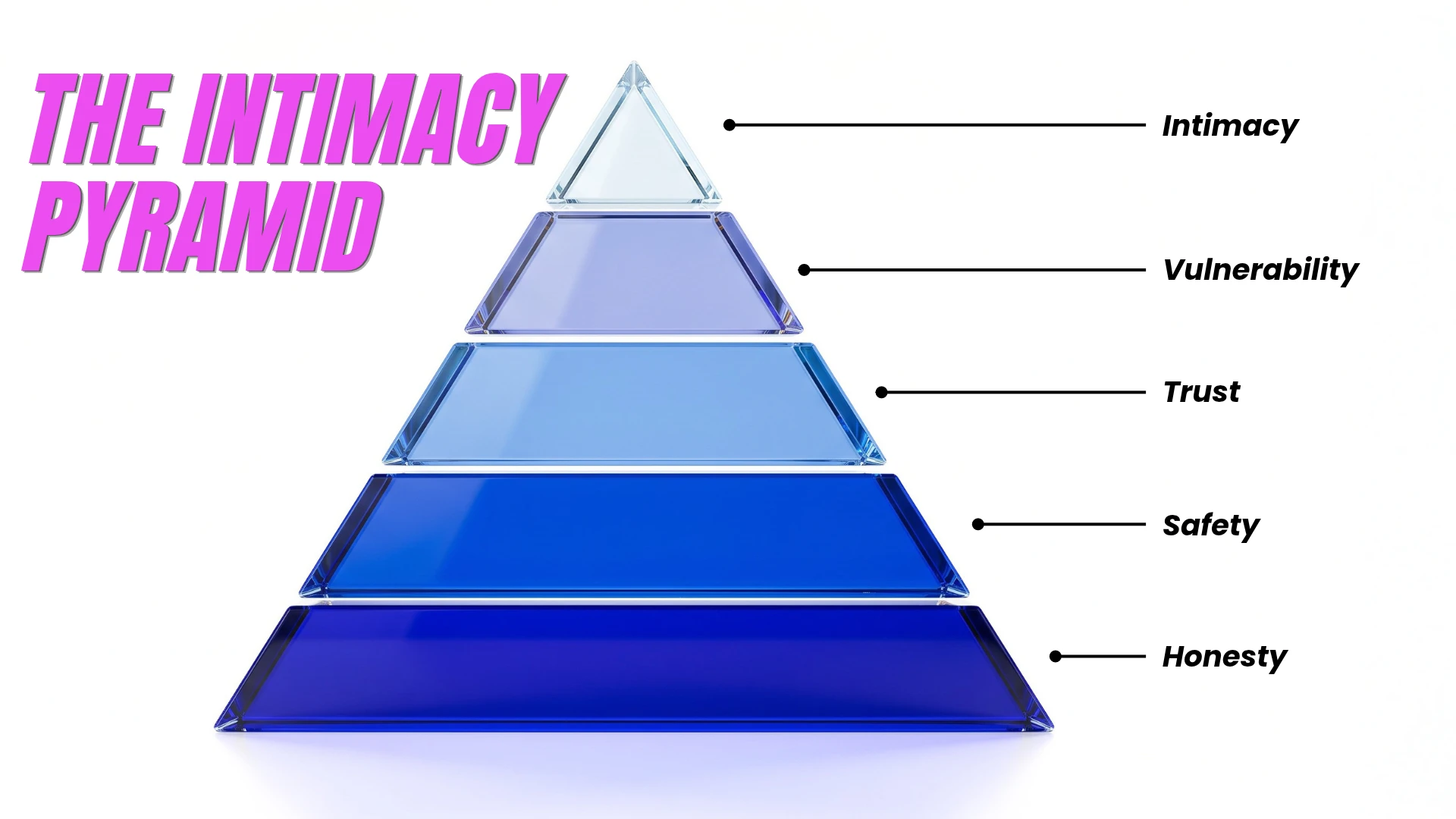
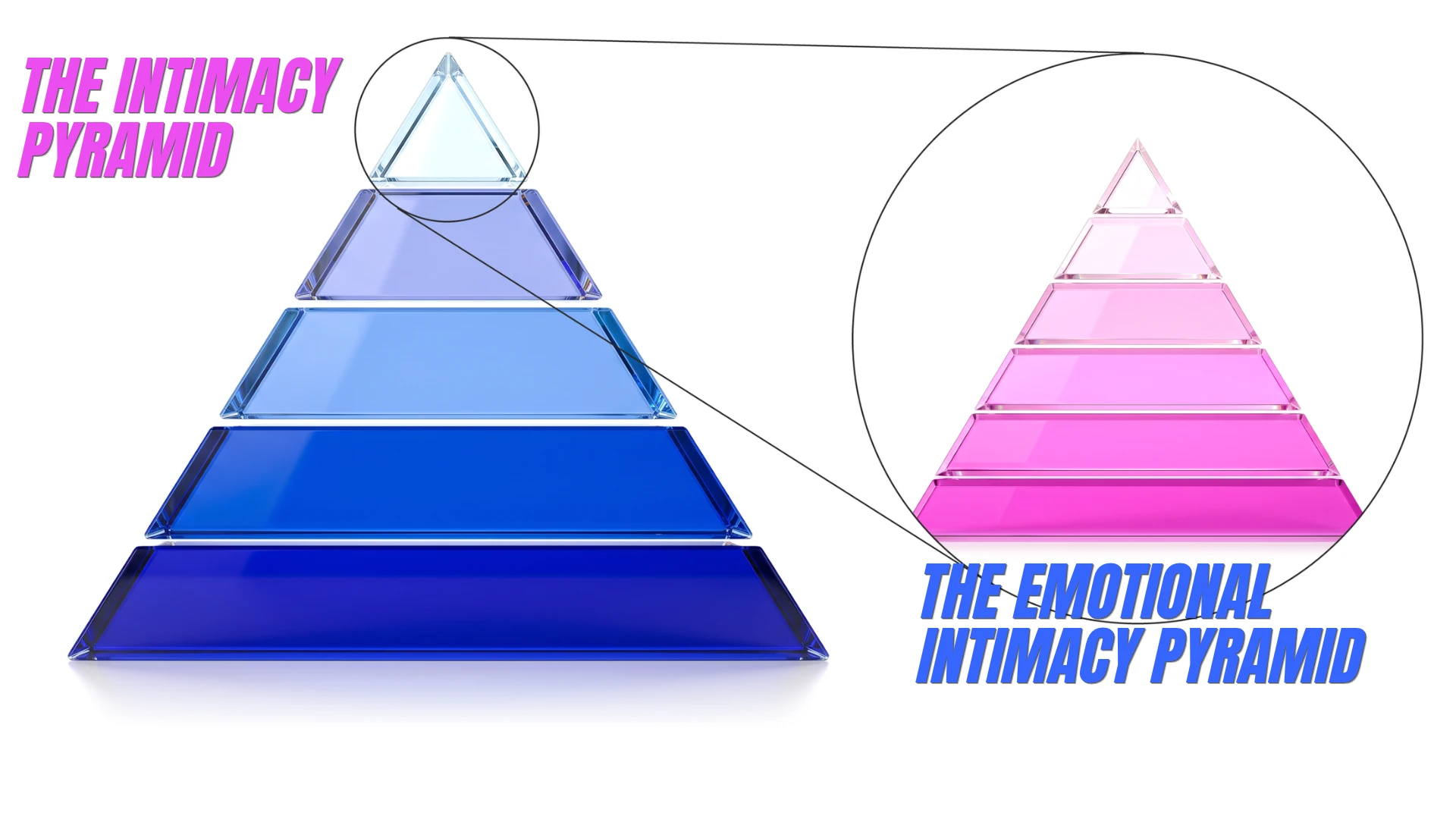
The two models answer different questions. The Intimacy Pyramid asks what a relationship needs in place before closeness is possible. The Emotional Intimacy Pyramid asks what closeness sounds like once you're talking. The way I see it, they work well side by side. Nobody tells a partner "I feel rejected when you do that" in a relationship where honesty and safety are shaky, and the upper layers of my pyramid are one picture of what vulnerability and intimacy sound like in an actual conversation.
And the "five levels of intimacy"?
You'll also find a communication-based "five levels of intimacy" model on many therapy websites, which moves from safe small talk to sharing needs and desires. The Emotional Intimacy Pyramid belongs to the same family. It differs in two places: it separates feelings about your own life from feelings about your partner, and it pays close attention to how the listener responds, which is where most conversations either deepen or stop.
When to get support
The Emotional Intimacy Pyramid is an educational tool for couples who feel stuck or distant. It isn't a diagnosis or a treatment plan. If your relationship has been through betrayal, addiction, coercion or any kind of violence, deeper disclosure can wait. Safety comes first, and that work is best done with a qualified couples therapist. If you don't feel physically or emotionally safe with your partner, start there. The National Domestic Violence Hotline is available at 1-800-799-7233 or thehotline.org.
Frequently asked questions
What are the six levels of the Emotional Intimacy Pyramid?
From the base up: the Social Layer, the First Date Layer, the Values Layer, the Stories & Beliefs Layer, the Feelings Layer, and the Intersubjective Layer. Each one asks you to reveal a little more of yourself than the one below.
Is the Emotional Intimacy Pyramid the same as the Intimacy Pyramid?
No. The Intimacy Pyramid is a five-layer model by Dan Drake, Joanna Raabsmith and Matthew Raabsmith, running from Honesty to Intimacy. The Emotional Intimacy Pyramid is my own six-layer model of conversation depth, based on Louis Ormont's Progressive Emotional Communication. The two aren't affiliated.
What does "intersubjective" mean in plain language?
It means between two people's inner worlds. At the Intersubjective Layer you share how you feel about your partner and the relationship, rather than how you feel about your own life.
Which level of intimacy is the hardest?
For most couples it's the top one, telling your partner how you feel about them. It carries the most risk, because the feeling is about the person you're telling.
How is emotional intimacy different from physical intimacy?
Physical intimacy is closeness through touch and sex. Emotional intimacy is the sense of being known, which comes from the conversations this pyramid describes. Many couples have one without the other, and each tends to feel richer when the other is there too.
Is the Emotional Intimacy Pyramid a research-validated test?
No. It's a clinical framework for understanding conversations, not a diagnostic tool or validated assessment. Its value is in giving a couple shared words for where their conversations stop and what to try next.
Sources
- Ormont, L. R. "Progressive Emotional Communication: Criteria for a Well-Functioning Group."
- The Center for Group Studies. Cultivating Progressive Emotional Communication in Group Psychotherapy (workshop, Jordan Price).
- Ury, L. Want to Improve Your Relationship? Start Paying More Attention to Bids. The Gottman Institute.
- Drake, D., Raabsmith, J., & Raabsmith, M. The Intimacy Pyramid (official site).
- Raabsmith, M., & Raabsmith, J. Building Intimacy in Your Relationship. The Raabsmith Team.