





Five new questions every Thursday, so you never have to think them up
You've got 45 questions on this page, and they'll last a few date nights. After that, most couples go back to "So... how was your day?" That's why I write Deepening Date Night.
- Five questions every Thursday morning, ready for the weekend
- Gentle to challenging in every set, so you build up the way the research says works
- Written by a licensed couples therapist, the same kind of questions I use with couples in my office
- Free, and you can skip any question
One email a week. Unsubscribe in one click.
How to ask intimacy questions so they actually work
A good question can still fall flat if it's asked badly. These are the habits I teach couples in my office.
Listen to understand, not to respond. While your partner is answering, you aren't preparing your reply or your defense. Your only job is to understand what they're telling you.
Say "Tell me more." When your partner finishes, don't jump in to relate, compare or reassure. "Tell me more" tells them you're still listening and you want to understand. Other follow-ups that work: "Help me understand," "What was that like for you?" and "I'm wondering if..."
Listen as if you've never heard it before. You may have heard the story about their dad a dozen times. Ask about how it felt, not just what happened, and you'll often hear something new.
Answer too. Take turns. Research on first meetings suggests people grow closer when both of them open up, not just one. A date night where one partner asks every question can start to feel like an interview.
Phones away, and pick your moment. Thirty minutes on the sofa with the TV off is plenty. The end of a fight, or the five minutes before someone leaves for work, is not.
What to do if a question lands badly
Sometimes a question opens up more than either of you expected. Your partner goes quiet, gets defensive or tears up. This doesn't mean the question was a mistake, and it doesn't mean you should stop.
- Slow down. You don't need to finish the question, or the set.
- Name what you're seeing, gently. "That seemed to hit something. Do you want to keep going, or come back to it?"
- Check your own story. Before you decide they're angry or shutting you out, ask yourself, "What story am I making up right now?" Then ask them.
- Pass is always an answer. Either of you can skip, and skipping isn't failing.
- Come back to it. "I've been thinking about what you said on Friday" is one of the most intimate sentences in a relationship.
45 Intimacy Questions to Ask Your Partner
Start at the top and work down. You won't get through all of them in one night, and you shouldn't try. Three or four good conversations make a better date than fifteen rushed answers.
Gentle intimacy questions
These ask about your life and your story, without getting too close to the bone.
- Which of our early dates would you happily repeat next week?
- What's one sweet or silly thing we used to do early on that you wish we still did?
- If our marriage had a theme song, what would it be?
- If you could choose anyone in the world as a dinner guest, who would it be?
- What's a small, ordinary day of ours you remember for no good reason?
- If we swapped roles for a day, what would you do first in mine?
- What family tradition do you love?
- What's a small habit of mine you secretly find funny?
- What rituals do we have as a couple that mean a lot to you?
- When did you last sing to yourself? To someone else?
Daring intimacy questions
These go into the feelings and stories under the facts.
- How has your idea of closeness changed since we've been together?
- What terrifies you most about our relationship?
- What did your family teach you about money, out loud or without saying it?
- Do you ever worry that our differences might become an issue later on?
- What do you wish I knew about you that's difficult to put into words?
- How would you describe your relationship with your parents right now?
- What can I do more of to help us feel renewed and refreshed when we're feeling burned out?
- What's one of the saddest memories from your childhood?
- How did your family deal with arguments when you were a kid?
- In what ways is our relationship similar to your parents' relationship, and in what ways is it different?
Challenging intimacy questions
Save these for when you've both warmed up. Take your time with them.
- Finish the line: "The thing I make up that you don't like about me is ___."
- What's something you've never told anyone?
- Have I ever made it difficult for you to be honest with me?
- What dream are you scared to go after, and what's stopping you?
- What are you most afraid of, and where do you think that fear originated?
- Is there something you're avoiding bringing up simply because you're not sure how I'll take it?
- What do you regret most, and do you still think about it?
- What would be the hardest thing for you to rebuild trust after?
- Can you share a moment when you felt my support helped you grow?
- Finish the line: "Something I've never said out loud to you is ___."
Intimacy questions about the two of you
Most lists only ask about the person. These ask about the relationship, which is where couples tend to get stuck.
- What can we do to encourage each other and support each other?
- What sort of affection or reassurance have you been lacking recently?
- What do you want from me that you've been reluctant to actually ask for?
- How does your history affect the way you speak to me when things get heated?
- What do you want me to do differently when we're arguing?
- Is there some recent miscommunication between us that still needs mending?
- Is there anything unresolved from last week that we should address now?
- How would you rank our communication this week on a scale of 1 to 10?
- Do you feel loved enough on a day to day basis and what would make a difference?
- Has anything I've ever said or done ever triggered an old wound for you and if so can you tell me about it?
Questions about love and affection
Intimacy includes how you show each other love. These ask how affection worked in the family you grew up in and how it feels between the two of you now. They're fine to skip.
- How did your parents show you that they loved you, if they did?
- When do you feel most loved by me in our relationship, and how can we create more of that?
- Do you think that I love you? And if so, what makes you think that?
- Who taught you how to love and fight as a kid, and what did you take from them?
- What did affection look like in your family when you were a kid, and what did you wish it had looked like?
For more like these, my deep questions to ask your partner go further into the past, trust and repair, and my date night questions for married couples run from fun and nostalgic to the weekly check-in, and the question game for couples turns questions like these into a spinning wheel. If you want the bigger picture, start with what emotional intimacy is and how to build it.
Can couples use the 36 questions to fall in love?
Yes, but most of what's said about them online is wrong. Here's what Aron's 1997 study actually found, from the paper itself:
- It tested strangers, not couples. The participants were college students paired with someone they didn't know.
- It measured closeness, not love. After 45 minutes, the question pairs felt closer than the small-talk pairs. Nobody measured falling in love.
- There was no eye-gazing. The famous "stare into each other's eyes for four minutes" step isn't in the study. The only four-minute item is "tell your partner your life story."
- Agreeing on things didn't matter. Pairs grew close whether or not they had been matched on attitudes.
- The marriage story is one line. The paper mentions, as an aside, one pair from an earlier version of the procedure who later married. It's an anecdote, not a finding.
The part almost nobody reports is what happened when the questions were tested on couples who were already together. In a 2014 study, dating couples who did the questions alone with each other showed no measurable increase in passionate love. Couples who did them with another couple did show one (Welker and colleagues, 2014).
So my advice for long-term couples is a little unexpected. Try the 36 questions on a double date. Find another couple you like, take turns, and let each couple hear the other's answers. The researchers found part of the boost came from how well the other couple listened. Watching someone else take a real interest in your partner seems to help you see them fresh.
Want a new set every week instead of the same 36?
Frequently asked questions
What are intimacy questions?
Intimacy questions are questions that invite your partner to share something about their inner life, such as a feeling, a memory, a fear or a hope, rather than facts or plans. They work best when they start gentle, build slowly and are followed by real listening.
Do intimacy questions have to be about sex?
No. Most intimacy questions are about emotional closeness: feeling known, understood and cared for. Questions about affection belong on the list too, and couples who feel emotionally close often find it easier to talk about desire. Start wherever feels comfortable for both of you.
How many intimacy questions should we ask in one night?
Three to five is plenty. One good question with three follow-ups will bring you closer than fifteen questions answered in a sentence each. That's why Deepening Date Night sends five a week.
What if my partner doesn't want to answer?
Let them pass, and don't treat it as rejection. Try a gentler question, answer one yourself first, or come back to it another night. If your partner never wants to talk about anything below the surface, that pattern is worth raising on its own, and a couples therapist can help.
Do the 36 questions work for couples who are already together?
The original study tested strangers. The one controlled study I've found on existing couples saw no boost in passionate love when couples did the questions alone, but did see one when they did them with another couple. Long-term couples can still use them. They may get more out of doing them on a double date.
How often should we ask each other questions like these?
Once a week is a good rhythm. It's often enough to become a habit, and not so often that it feels like homework. That's the rhythm Deepening Date Night is built on.
Sources
- Aron, A., Melinat, E., Aron, E. N., Vallone, R. D., & Bator, R. J. (1997). The experimental generation of interpersonal closeness: A procedure and some preliminary findings. Personality and Social Psychology Bulletin, 23(4), 363–377. https://doi.org/10.1177/0146167297234003
- Aron, A., Norman, C. C., Aron, E. N., McKenna, C., & Heyman, R. E. (2000). Couples' shared participation in novel and arousing activities and experienced relationship quality. Journal of Personality and Social Psychology, 78(2), 273–284. https://doi.org/10.1037/0022-3514.78.2.273
- Huang, K., Yeomans, M., Brooks, A. W., Minson, J., & Gino, F. (2017). It doesn't hurt to ask: Question-asking increases liking. Journal of Personality and Social Psychology, 113(3), 430–452. https://doi.org/10.1037/pspi0000097
- Kardas, M., Kumar, A., & Epley, N. (2022). Overly shallow?: Miscalibrated expectations create a barrier to deeper conversation. Journal of Personality and Social Psychology, 122(3), 367–398. https://doi.org/10.1037/pspa0000281
- Laurenceau, J.-P., Barrett, L. F., & Rovine, M. J. (2005). The interpersonal process model of intimacy in marriage: A daily-diary and multilevel modeling approach. Journal of Family Psychology, 19(2), 314–323. https://doi.org/10.1037/0893-3200.19.2.314
- Savitsky, K., Keysar, B., Epley, N., Carter, T., & Swanson, A. (2011). The closeness-communication bias: Increased egocentrism among friends versus strangers. Journal of Experimental Social Psychology, 47(1), 269–273. https://doi.org/10.1016/j.jesp.2010.09.005
- Welker, K. M., Baker, L., Padilla, A., Holmes, H., Aron, A., & Slatcher, R. B. (2014). Effects of self-disclosure and responsiveness between couples on passionate love within couples. Personal Relationships, 21(4), 692–708. https://doi.org/10.1111/pere.12058
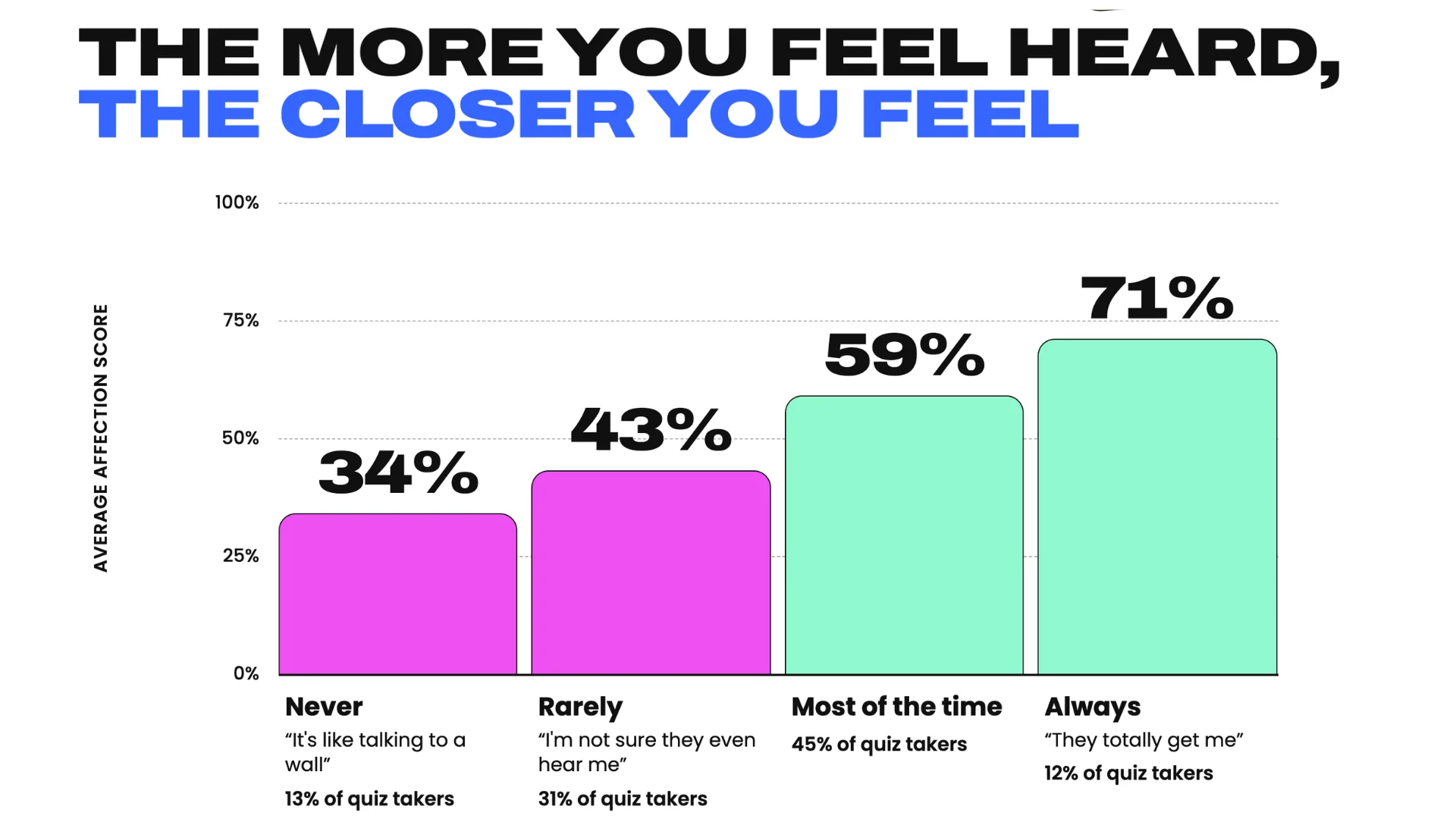
- CARE & Intimacy Quiz data, Oliver Drakeford Therapy (2,224 quiz starts at time of writing). Percentages are of people who answered each question.